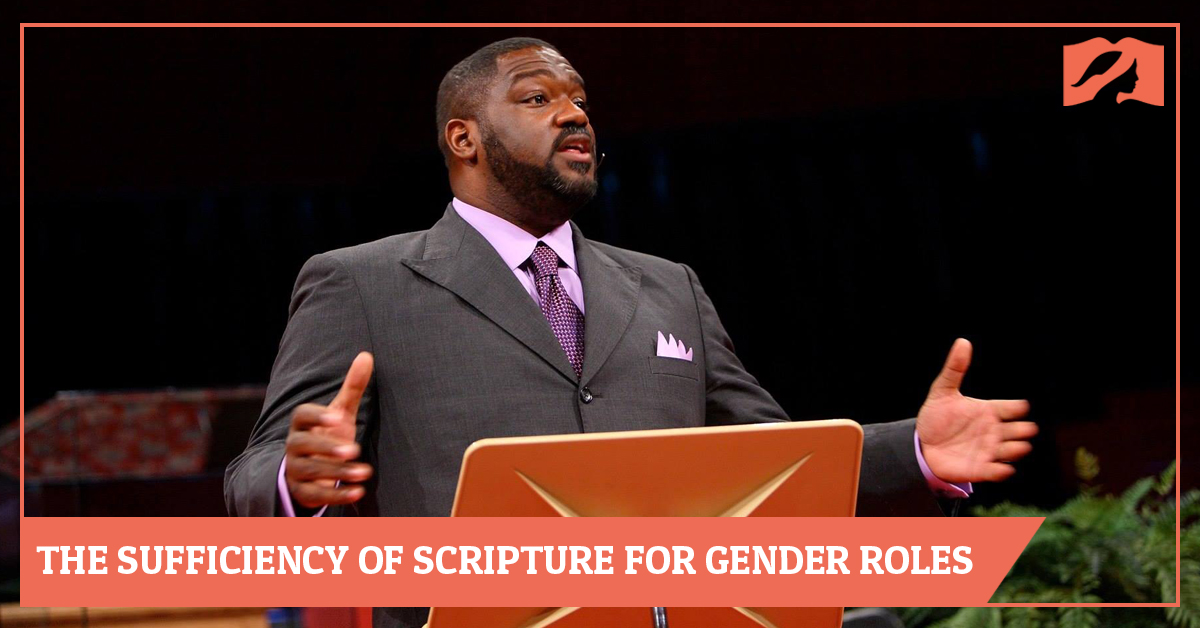
Preacher: Dr. Voddie Baucham | Sermon Length: 46min 53sec | Preached: December 12, 2009
Voddie Baucham is dean of the seminary at African Christian University and previously served as Pastor of Preaching at Grace Family Baptist Church in Spring, TX. He has authored numerous books, academic journals, and magazine articles.
SERMON COORDINATOR NOTES: This lecture provides the listener with a clear, concise articulation of the Scriptural basis for distinct gender roles among men and women. Addressing the popular notions of culture, Dr. Baucham shows how the relativism of today is contrary to the Word of God.
>> In addition to streaming this sermon or watching it above, you can also download it.
Heard a good sermon on head covering or biblical manhood/womanhood? Tell us about it here.
Christian head covering is not a new belief. It is a practice with a long history that has been largely forgotten in the 21st century. Similar to the Reformers of years past, the goal of each generation of reformers is not to invent new doctrines, but to re-discover the old ones.
The 19th-century preacher Charles Spurgeon helped do this for the Doctrines of Grace, also known as Reformed theology. Although this system of Protestant beliefs was the dominant view during the Puritan age in England, during Spurgeon’s time it was a minority (and largely-forgotten) position. Steven Lawson explains the situation:
When Charles Spurgeon burst onto the scene in the mid-19th century, he appeared heralding the doctrines of sovereign grace. At that time, Calvinism was no longer the dominant theology in England, as it had been in Puritan times. Instead, the doctrines of grace were becoming obscured from public view, cast aside as dusty and archaic relics of primitive 16th-century Europe. Victorian England had come of age, it was supposed, and its philosophers championed the autonomy of man, not the sovereignty of God. The teaching of the Reformation had all but faded from the evangelical scene. But rather than becoming infatuated with the current theological fads, Spurgeon chose to stay true to the old paths, those laid out in Scripture long ago, including the teachings of sovereign grace. He said: “It is no novelty, then, that I am preaching; no new doctrine. I love to proclaim these strong old doctrines, that are called by nickname Calvinism, but which are surely and verily the revealed truth of God as it is in Christ Jesus.” (Lawson 37-38) 1) Lawson, Steven J. The Gospel Focus of Charles Spurgeon. Reformation Trust Publishing, 2012.
Spurgeon is affectionately honored as the “Prince of Preachers,” not because he was a clever man who devised new theological fads, but because of his bold proclamation of doctrinal truths that had been forgotten in his generation. It is easy for the people of God to forget. We take the Lord’s supper regularly “in remembrance of [Jesus]” (1 Cor. 11:24 ESV) — because we are prone to forget. Every generation must take up the task of teaching Christian beliefs afresh, so that they will not be lost to the pages of history.
In Spurgeon’s day, the practice of head covering was not an abandoned doctrine but something that was commonplace. Referring to his own church, he wrote:
The reason why our sisters appear in the House of God with their heads covered is ‘because of the angels.’ The apostle says that a woman is to have a covering upon her head because of the angels, since the angels are present in the assembly and they mark every act of indecorum, and therefore everything is to be conducted with decency and order in the presence of the angelic spirits. (Spurgeon 98) 2) Spurgeon, Charles Haddon. Spurgeon’s Sermons on Angels. Kregel Academic, 1996.
Spurgeon understood that the reason for head covering was not related to first-century culture, but rather to the angelic spirits (who transcend time, place, and culture).
Charles Spurgeon had a profound impact in both Christian theology and practice. Partly due to his influence, Reformed theology is more widely accepted nowadays. While the same cannot be said for the practice of head covering (yet!), the same principle applies. We must follow Spurgeon’s example by “[staying] true to the old paths, those laid out in Scripture long ago” (Lawson 38). 3) Lawson, Steven J. The Gospel Focus of Charles Spurgeon. Reformation Trust Publishing, 2012.
References
1.
↑ Lawson, Steven J. The Gospel Focus of Charles Spurgeon. Reformation Trust Publishing, 2012.
2.
↑ Spurgeon, Charles Haddon. Spurgeon’s Sermons on Angels. Kregel Academic, 1996.
3.
↑ Lawson, Steven J. The Gospel Focus of Charles Spurgeon. Reformation Trust Publishing, 2012.
Nikolaos Seferiadis is the pastor of Trinity International Baptist Church in Athens, Greece. He is married to Stavroula and they have two daughters.
SERMON COORDINATOR NOTES: This sermon provides a concise exegetical approach to the passage looking at the flow of the argument, the Greek used in the text, and addressing the arguments against covering.
>> In addition to streaming this sermon or watching it above, you can also download it.
Heard a good sermon on head covering or biblical manhood/womanhood? Tell us about it here.
In this video, I respond to a new clip posted of Steven Anderson where he argues against head covering. He gives two objections to substantiate his belief that 1 Corinthians 11 is only dealing with hair lengths (not a material covering). Watch the video below and then feel free to check out the additional links at the bottom.
In this clip I respond to a video posted on Christianity.com from Mary Mohler. Mary directs the Seminary Wives Instutite at the Southern Baptist Theological Seminary where her husband, Albert Mohler serves as president. In this video Mary answers the question “Should women wear head coverings in church services?” I’ll let you watch her answer in its entirety, while I interject with some thoughts on her main points.
Note: In case you’re wondering, I highly respect the Mohlers and think S.B.T.S. is a fantastic seminary. Though I see this issue differently than them, we agree on far more than we disagree. This is a friendly response to help you, the viewer, think through common objections to this practice.