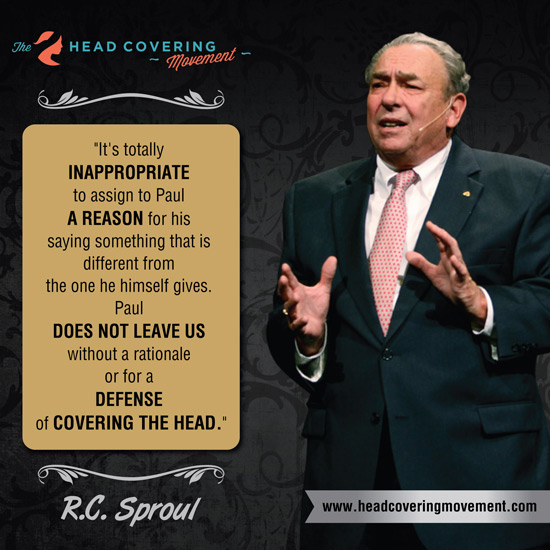
In this video, R.C. Sproul shares what he believes about Christian head covering. He gives his answer in the context of teaching how to properly interpret the Bible as it relates to customs and principles. The book he references (Knowing Scripture) can be purchased here (affiliate) on Amazon.
This video was taken from the 2004 Shepherd’s Conference. He is sitting next to John MacArthur and R. Albert Mohler. You can watch the entire Q&A here.
Dr. R.C. Sproul (1939-2017) was the founder and chairman of Ligonier Ministries, an international Christian education ministry located near Orlando, Florida. His teaching can be heard on the program Renewing Your Mind, which is broadcast on hundreds of radio outlets in the United States and in 40 countries worldwide. He was the executive editor of Tabletalk magazine, general editor of The Reformation Study Bible, and the author of more than seventy books. Dr. Sproul also served as president of Ligonier Academy of Biblical and Theological Studies and Reformation Bible College. He served as senior minister of preaching and teaching at Saint Andrews Chapel in Sanford, FL.
PRINCIPLE AND CUSTOM
Unless we conclude that all of Scripture is principle and thus binding on all people of all ages, or that all Scripture is local custom with no relevance beyond its immediate historical context, we are forced to establish some categories and guidelines for discerning the difference.
To illustrate the problem let’s see what happens when we hold that everything in Scripture is principle and nothing merely a reflection of local custom. If that is the case, then some radical changes must be made in evangelism if we are going to be obedient to Scripture. Jesus says, “Carry no money belt, no bag, no shoes; and greet no one on the way” (Lk 10:4). If we make this text a transcultural principle, then it is time for all evangelists to start preaching in their bare feet! Obviously, the point of this text is not to set down a perennial requirement of barefooted evangelism.
Other matters, however, are not so obvious. Christians remain divided, for example, on the foot-washing rite (see Jn 13:3-17). Is this a perpetual mandate for the church of all ages or a local custom illustrating a principle of humble servanthood? Does the principle remain and the custom vanish in a shoe-wearing culture? Or does the custom remain with the principle regardless of foot apparel?
To see the complexities of the dilemma, let’s examine the famous hair-covering passage of 1 Corinthians 11. The New Revised Standard Version translates this to require a woman to cover her head with a veil when she prophesies. In applying this command to our culture we are faced with four distinct options: Read more