Preacher: Rev. Armen Thomassian | Sermon Length: 54 min 20 sec | Preached: June 10, 2018
Born in Scotland and raised in Northern Ireland, Rev. Armen Thomassian was delivered from the folly of atheism and brought to saving faith in Jesus Christ at the age of 19. He was sent to Australia in 2007 by the Mission Board of the Free Presbyterian Church of Ulster to supply pulpits in South Australia and Tasmania. He returned in 2009 to commence training for the ministry, graduating in 2014. A few weeks later he received and subsequently accepted a call from across the Atlantic to Calgary Free Presbyterian Church and commenced his ministry there in January 2015. After ministering in Calgary for four years, he was installed as minister of Faith Free Presbyterian Church in January 2019.
SERMON COORDINATOR NOTES: This sermon provides a foundational overview of the topic of head coverings, providing exegesis on 1 Corinthians 11:2-16, and addressing popular arguments against the use of head coverings.
>> In addition to streaming this sermon or watching it above, you can also download it.
Heard a good sermon on head covering or biblical manhood/womanhood? Tell us about it here.
Editor’s Note: The Head Covering Movement team is made up of men and women from various denominations and does not endorse a specific style or form of worship as a core tenet of HCM. This article is intended to describe a worship philosophy that arose during the Protestant Reformation, which is helpful to consider as it challenges us to rely on Scripture as our guide for all of life and helps us to see why the practice of head covering is appropriate for Christian worship everywhere.
Imagine you were given the opportunity to meet the Queen of England. It’s likely you wouldn’t wing it, arriving in your favorite comfy outfit to share some personal stories about your family dog. Instead, you’d probably study to find out what you are supposed to do when you were in her presence. Likewise, we should be thoughtful as to how we enter God’s presence in worship as a church body. During the Protestant Reformation (roughly 1517-1648), one of five key doctrines to emerge was sola scriptura, which is Latin for “Scripture alone.” This means that the Bible is our source of truth and provides our only infallible rule of faith and practice. This doctrine guards against elevating church tradition, personal experience, or reason to an equal level of authority with God’s revealed will in the Bible.
Scripture Guides Us
A primary purpose of God’s Word is the self-disclosure of Himself to His people. This includes how we are to worship Him with our lives, and how we worship Him in corporate worship—our time gathered with other believers on the Lord’s Day. Two primary schools of thought emerged during the Reformation: the earliest Protestant reformer, Martin Luther, applied sola scriptura to worship by saying that anything which may be edifying is permissible in gathered worship if it is not forbidden in Scripture: “I condemn no ceremony except such as are opposed to the gospel; all the rest I leave intact within the church.” 1) Tanner, Craig. “NPW vs. RPW.” Avoiding Evil, 2004, http://www.tbcsullivan.com/avoidingevil/2004/03/05/npw-vs-rpw/.
This became known as the “Normative Principle of Worship” and is the prevailing approach to corporate worship in North American churches. Essentially it states that Scripture makes clear things we should not do in worship; that is, we should avoid anything obviously sinful. Many faithful Christians adhere to this worship philosophy, seeking to legitimately honor God’s Word in their worship by not violating God’s commands during their times of gathered worship.
However, another view became much more widely held among the “Reformed” (Protestant non-Lutheran) groups. It was eventually known as the Regulative Principle of Worship (RPW). This concept also applied sola scriptura, but instead of asking what we may do in gathered worship, it states Scripture is sufficient to tell us what we shoulddo in worship. This principle states that God, through His Word, commands certain distinct elements for corporate worship, such as singing, praying, and preaching. 2) The key elements of corporate worship laid out in God’s Word are reading the Bible (1 Tim. 4:13); preaching the Bible (2 Tim. 4:2); singing the Bible (Eph. 5:19; Col. 3:16) — Psalms and other songs that accurately reflect the teaching of Scripture; prayer (Matt. 21:13), and administration of the two sacraments: baptism and the Lord’s Supper (Matt. 28:19; Acts 2:38–39; 1 Cor. 11:23–26). Some would also include a few other elements like taking offerings (1 Cor 16:2) and installing church officers (Acts 6:1-6). The above biblically-prescribed church service elements are clearly spelled out within many of Christianity’s historical creeds.
Any additional elements not found in Scripture must be left out. (Full disclosure: I, the writer of this article, subscribe to this view.) There may be some variation in how the elements are executed (sermon length, number of songs, etc.), but the actual service components are those which are prescribed in Scripture.
The basis for this principle is that God is perfect, holy, and transcendent beyond our imagining; we are redeemed-yet-flawed created beings and cannot rightly come up with how we ought to enter His presence in worship. Instead, we must worship God together on His terms, according to His guidelines made known in His Word — especially through Jesus’ teachings, the apostles’ writings, and New Testament church practice carried out under apostolic oversight. The Regulative Principle emphasizes that we must not add to or take away from God’s Word 3)Deut. 4:2, Deut. 12:32, Rev. 22:18-19.
and “that worship is of God, by God, and for God.” 4) Hyde, Daniel. “What Is the Regulative Principle of Worship?” Ligonier, 2017, https://www.ligonier.org/blog/what-regulative-principle-worship/.
Read more
References
1.
↑ Tanner, Craig. “NPW vs. RPW.” Avoiding Evil, 2004, http://www.tbcsullivan.com/avoidingevil/2004/03/05/npw-vs-rpw/.
2.
↑ The key elements of corporate worship laid out in God’s Word are reading the Bible (1 Tim. 4:13); preaching the Bible (2 Tim. 4:2); singing the Bible (Eph. 5:19; Col. 3:16) — Psalms and other songs that accurately reflect the teaching of Scripture; prayer (Matt. 21:13), and administration of the two sacraments: baptism and the Lord’s Supper (Matt. 28:19; Acts 2:38–39; 1 Cor. 11:23–26). Some would also include a few other elements like taking offerings (1 Cor 16:2) and installing church officers (Acts 6:1-6). The above biblically-prescribed church service elements are clearly spelled out within many of Christianity’s historical creeds.
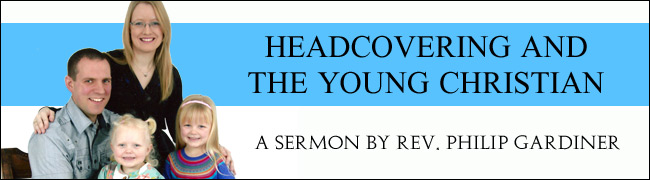
Philip Gardiner has been the minister of Carrickfergus Free Presbyterian Church in Northern Ireland since January 2007. He was trained at the Whitefield College of the Bible (Northern Ireland). He is currently awaiting confirmation of a visa to go to Australia to be the minister in Perth Free Presbyterian Church. He is married to Cherith and they have two young daughters.
This sermon was preached on Nov 18, 2012 at a youth meeting in Mount Merrion FPC in Belfast. Though it was delivered to youth, it is a sermon that transcends age. In only 38 minutes Philip Gardiner makes a positive case for head covering, speaks about the various objections and explains the principle of headship which the symbol points to. In such a short time he covers an astonishing amount of ground, thoroughly. One thing that stands out in this sermon is Philip’s heart and concern for the things that are greater than the symbol of covering. He asks of the Lord in prayer, “that our lives might be brought into conformity to the Word of God, not merely in the outward practice, but also in the heart“. He shows concern that some objections (particularly, seeing Paul as a Chauvinist–bringing his own cultural views of men/women into the Scripture) undermine the inspiration of Scripture. Also at the end he makes an appeal for everyone to be under the more important covering, the “covering that there is in the precious blood…that covers your sin”. We commend this sermon to you as a short, but jam-packed introduction to head covering.
>>> In addition to streaming this sermon above, you can also download it.