While we hope that Scripture’s teaching on Biblical Womanhood has first and foremost affected your heart and behavior, have you allowed it to speak to your appearance and wardrobe too?
Have you allowed Scripture's teaching on Biblical womanhood to speak to your appearance and wardrobe?
Click to Tweet
In 1 Corinthians 11, the Apostle Paul instructs women to cover their heads while praying or prophesying. For 1900 years, the church understood Paul to be speaking of an artificial covering such as a veil or scarf. However, in the 20th century, a view began to gain popularity which argued that Paul wasn’t speaking about veils, but hair lengths. In this video we’ll overview this debate and provide 5 reasons for why we believe a woman is to cover her long hair with an artificial covering when praying or prophesying.
This video is an adaptation of an article we wrote here.
[Series introduction:This post is part of a series that examines what certain leaders in church history believed about head covering. Their arguments, choice of language and conclusions should not be misconstrued as an endorsement from us. The purpose of this series is to faithfully show what they believed about covering rather than only selectively quoting the parts we agree with.]
Thomas Wall (17th Century) is the author of numerous works including “Baptism Anatomized”, “A Comment on the Times” and “Tythes, No Gospel”. He lived in the United Kingdom and was actively writing in the late 17th century.
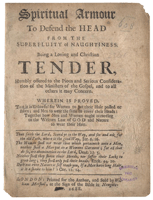
In 1688, Thomas Wall published a book entitled “Spiritual Armour To Defend the Head From the Superfluity of Naughtiness.” It was a passionate rebuke of men wearing their hair long (contrary to 1 Cor 11:14) and women cutting their hair short (contrary to 1 Cor 11:15). This was a widespread issue, which Wall says was “suffered in almost every Congregation that say they are the Churches of God.” He said that this “sin is so generally spread, that it is as a Leprosie”. He hoped that his book would help Christians take seriously what God’s word and nature teaches us about our hair.
The Apostle Paul’s reason for proper hair lengths is “grounded in God’s order in Nature” and was for people “in all ages”. Read more
The Objection: It is not natural for all women to have long hair. Many women cannot grow their hair long even if they wanted to. Since entire people groups (African women for example) could leave their hair uncut and it still be short, it’s unfair to say all women should have it long.
It is often pointed out that some women don’t possess the ability to grow their hair long. If that is so, how can we say it’s natural for them to have long hair? First it’s important to establish that by “long hair” we don’t mean that all women worldwide must wear their hair long according to Western standards. “Long” must be understood culturally in contrast to the length of mens short hairstyles. Just like dressing modestly, there are some outfits which clearly do not fit the label no matter the culture. Likewise, there are some hairstyles which couldn’t be called ‘long’ no matter where one lives. However, there is a fair amount of subjectivity to it as well. A North American definition of modest attire for example, will actually be seen as immodest in some middle-Eastern countries. Likewise, we must not import our definition of “long” to other people groups where the texture of their hair differs or their short/long styles don’t parallel ours.
A Broken Picture
Once we’ve allowed some flexibility with our definition of long, there still remains the fact that some women cannot grow their hair to a length that would be considered “long” in their culture. Read more