fbpx

Navigate / search

The Understanding Test

The Understanding Test

Have you ever engaged someone in a friendly debate only to hear them say, “That’s not what I really believe” or “That’s not what I mean?” I’ve said that to others and have heard that said back to me. This often happens when we learn about a position from someone who doesn’t hold to it. Though it may be unintentional, when we disagree with a position we will usually not present it in the same way as if we agreed with it.

So how do we know if we truly understand a viewpoint or doctrine? Do we really understand Buddhism and Islam? Calvinism and Arminianism? How about the various views on head covering? How would we know if we really do understand them? Read more

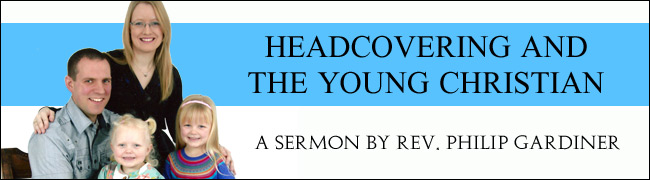
Headcovering and the Young Christian (Sermon)

Headcovering and the Young Christian
Philip Gardiner has been the minister of Carrickfergus Free Presbyterian Church in Northern Ireland since January 2007. He was trained at the Whitefield College of the Bible (Northern Ireland). He is currently awaiting confirmation of a visa to go to Australia to be the minister in Perth Free Presbyterian Church. He is married to Cherith and they have two young daughters.

This sermon was preached on Nov 18, 2012 at a youth meeting in Mount Merrion FPC in Belfast. Though it was delivered to youth, it is a sermon that transcends age. In only 38 minutes Philip Gardiner makes a positive case for head covering, speaks about the various objections and explains the principle of headship which the symbol points to. In such a short time he covers an astonishing amount of ground, thoroughly. One thing that stands out in this sermon is Philip’s heart and concern for the things that are greater than the symbol of covering. He asks of the Lord in prayer, “that our lives might be brought into conformity to the Word of God, not merely in the outward practice, but also in the heart“. He shows concern that some objections (particularly, seeing Paul as a Chauvinist–bringing his own cultural views of men/women into the Scripture) undermine the inspiration of Scripture. Also at the end he makes an appeal for everyone to be under the more important covering, the “covering that there is in the precious blood…that covers your sin”. We commend this sermon to you as a short, but jam-packed introduction to head covering.

>>> In addition to streaming this sermon above, you can also download it.

A Response to “Of Hats and Head Coverings” by Rob Slane (as posted on American Vision)

"Of Hats and Head Coverings" A Response
This article is a response to “Of Hats and Head Coverings (1 Corinthians 11:1-17)” by Rob Slane. We recommend reading his argument in full before reading our response. We’re thankful that American Vision decided to post on this topic as it’s causing many people to look deeper into their Bibles and study 1 Corinthians 11. Though we disagree on many points, we appreciate the respectful, well thought out argument and the invitation to dialogue.

An article was recently published on the American Vision website putting forth a new interpretation of head covering (1 Cor 11). The article was written by Rob Slane and it shares many things in common with the position we advocate (head covering as a timeless symbol). Rob shares that he’s familiar with the debate but doesn’t find any of the three major positions on head covering persuasive (long hair, cultural or it being a timeless symbol). He then shares his understanding of 1 Corinthians 11 “to try and generate some comment”. He calls his position a “minority view” and said he doesn’t expect “anyone to agree with it”. However, he raises many good points that are worthy of contemplation and discussion. I’d like to first articulate back my understanding of Rob’s position and then respond to many of the points he raises. Read more

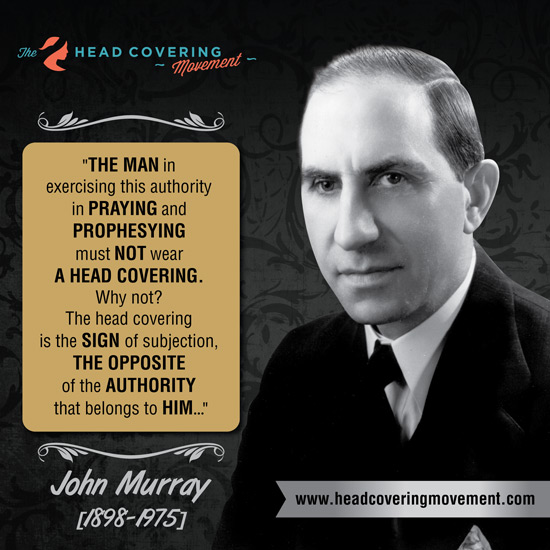
John Murray Quote Image #2

John Murray Quote Image #2

Source: John Murray – Head Coverings and Decorum in Worship: A Letter (1973) – Point 4a

Thanks to Westminster Archives for providing the picture 🙂

Is Head Covering Christian Liberty or a Command?

Is Head Covering Christian Liberty or a Command?
Is head covering a matter of Christian liberty or is it a command that is binding on all Christians?

What is Christian Liberty?

Christian liberty is a Christian’s right to make their own decision on issues that are not commanded by God. With these types of issues there are biblical parameters that limit our choices and biblical principles that should inform our choices, but there is not only one correct answer for all Christians. This idea is taught in Romans 14 where the Apostle Paul says: Read more

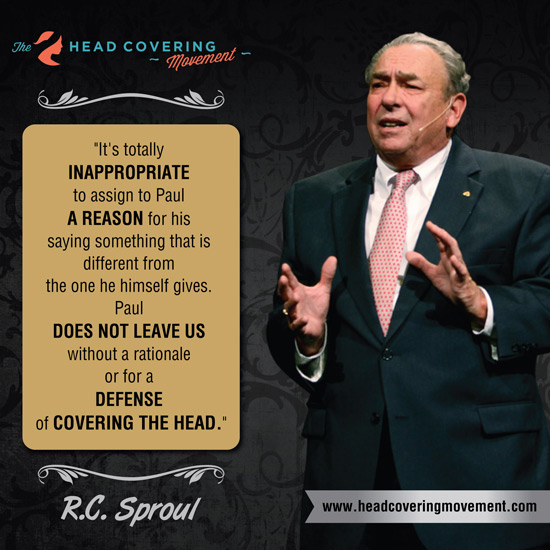
R.C. Sproul Quote Image #2

“For this reason…” – The Apostle Paul on Head Coverings (1 Cor 11:10a NKJV)

R.C. Sproul Quote Image #2

If this quote has piqued your interest, listen to the sermon clip where Dr. Sproul expands on his statement.

Is a Woman’s Hair “Pinned Up” Her Covering?

Is A Woman's Hair "Pinned up" Her Covering?
The Objection: The Greek word “Akatakalyptos” is incorrectly translated as “uncovered” or “unveiled” in English translations of the Bible. A more accurate rendering would be “unloosed”. Paul is not commanding women to wear a head covering, but is telling them to pin/bundle their hair up instead of letting it hang down their backs.

This view was articulated by James B. Hurley (Professor of Marriage and Family Therapy, RTS Jackson) who said:

…the custom in view was not the wearing of the shawl but rather the wearing of that hair style which marked a woman in proper relation to her husband or father. It was the custom of women to wear their hair pinned up in a “bun” rather than hanging loose. 1) Did Paul Require Veils or the Silence of Women? A Consideration of 1 Cor 11:2-16 and 1 Cor 14:33b-36 (Volume: WTJ 35:2 – Winter 1973)

How is this view supported? Dr. Hurley says the most “fruitful text” to study is how the Septuagint translates Leviticus 13:45. The Septuagint (also known by the abbreviation, LXX) is a Koine Greek 2) The language the New Testament was written in. translation of the Old Testament. It was the Bible used by Greek speakers in the time of Jesus and the Apostles. So let’s first take a look at this passage Dr. Hurley mentioned with a special focus on the Hebrew 3) The language the Old Testament was written in. word behind hair “hanging loose”. Read more

References

1.
 Did Paul Require Veils or the Silence of Women? A Consideration of 1 Cor 11:2-16 and 1 Cor 14:33b-36 (Volume: WTJ 35:2 – Winter 1973)
2.
 The language the New Testament was written in.
3.
 The language the Old Testament was written in.
Send this to a friend