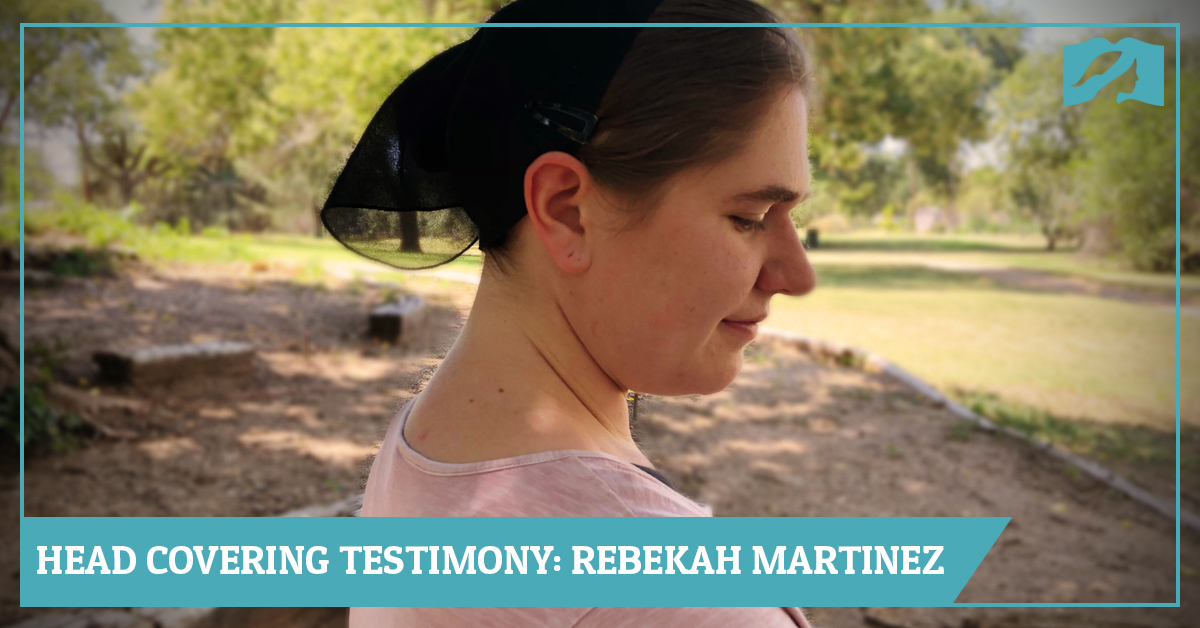
Name: Rebekah Martinez | Age: 24 | Location: Texas | Date started covering: October 2021
The Unexpected Blessings of Head Covering
When I first began to feel convicted to cover my head, I was a little confused. I had never known anyone who practiced this, and I wasn’t sure if I was understanding correctly. It was at a time in my life when I had been praying for change: for my home to be filled with more joy and peace, for direction, and for my husband to step more into his role as the spiritual leader of our home. I didn’t understand where head covering would fit in with this, but I began researching and trying to understand.
I read 1 Corinthians 11 and it became clear to me.
In fact, I have seen many unexpected blessings in my life since beginning to cover!Read more
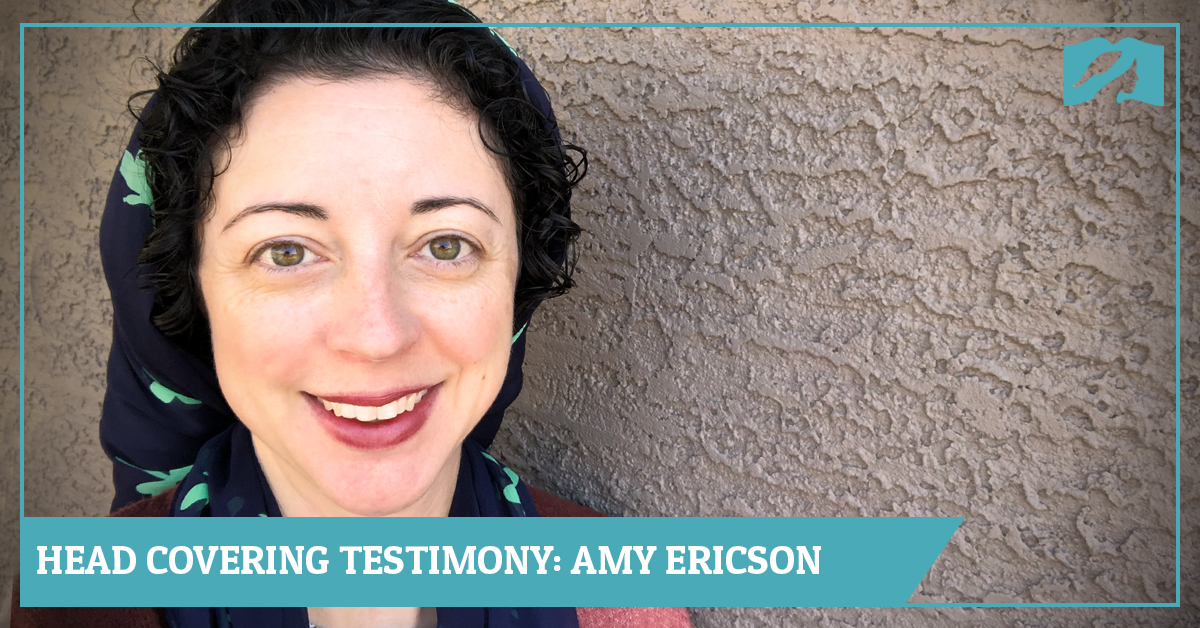
Name: Amy Ericson | Age: 41 | Location: Phoenix, Arizona | Date started covering: 2018
1) Introduce yourself to our readers.
My husband and I, both followers of Jesus Christ, were married in 2003 at the age of 23. We lived in Indianapolis until God invited us to live in Abu Dhabi, UAE (United Arab Emirates) in 2008. Our time there ended in 2019 when we then moved to our current city of Phoenix, Arizona. We have three kids – ages 11, 9, and 6 – all of whom we homeschool.
2) Where do you attend church? Tell us a little bit about it. Do others practice head covering there?
We currently attend Grace Church of Peoria, in a suburb of Phoenix. It is four miles from my home and filled with awesome, faithful followers – many of whom are similar to us in how they live and run their homes. I am currently the only woman who wears a head covering at my church. I’ve had one young, single gal ask me about my head covering. I believe, with a little bit of encouragement, she will want to start wearing one as well.
Remarkably, I just found out last Sunday that a new friend at church is considering donning a head covering! She’s been convicted about it and now she’s just getting comfortable with the idea. She was inspired to see me wearing one when they first started attending our church a few months ago.
3) What led you to start covering?
I had not heard a good sermon on 1 Corinthians 11:2-16 before and thought that head covering was just something a certain, super-conservative denomination practiced. At first, I did not associate it with the authority structure that God has laid out in the Bible.Read more
I remember once hearing someone remarking to another person, “I guess it’s normal in marriage for a couple to argue. I don’t see how you can be married and not argue.” I looked over at the person who had been listening to watch for her reaction. She blinked. Then she said, “Well, my husband and I never argue.” And that was the end of that conversation.
Which of the following scenarios sounds most typical: a marriage where arguing is common, a marriage where arguing never happens, or something in between? I know where I find myself on that spectrum.
Naturally, as a woman who wears a head covering to church every Sunday as a symbol of submission to the leadership of my husband (see 1 Cor. 11:2-16), I feel especially vulnerable to scrutiny on this point. For example, if I were to wear a head covering but argue with my husband regularly, what would that make me? I shudder at the thought.
Whatever may be typical for us, the Bible clearly states what should be the norm for followers of Christ:
Do everything without grumbling or arguing, so that you may become blameless and pure, “children of God without fault in a warped and crooked generation.” (NIV, Phil. 2:14-15a)
It is to one’s honor to avoid strife, but every fool is quick to quarrel. (Prov. 20:3)
It also says these strong words about argumentative wives:
Better to live in a desert than with a quarrelsome and nagging wife. (Prov. 21:19)
and
Better to live on a corner of the roof than share a house with a quarrelsome wife. (Prov. 25:24)
Clearly, God’s goal for us is to be peaceful in our interactions with others and to avoid argumentative habits. Yes, that’s the goal — but unfortunately we don’t always live up to it. What then? Do we stop wearing a head covering because it makes us feel hypocritical?
That’s a good question, and I believe I have an equally good answer.
Here’s the way I, personally, view the head covering: It’s a practical life tool.Read more
“When obedience to God contradicts what I think will give me pleasure, let me ask myself if I love Him.” – Elisabeth Elliot
Do you struggle with the fear of what other people will think of you for covering your head?
Most of us who cover probably have. When I first began to drape a scarf over my hair in church, I was petrified. I was the only one. While my husband and I were wholly convinced that this is what Scripture mandates and were glad to follow it, my personality is that of someone who strongly dislikes sticking out or doing anything that causes people to notice.
Would I lose old friends? Repel potential friends? Be gossipped about?
What would others think? Would they think I was legalistic, doing this because I believed it made me better in God’s eyes? Would they think that I sat in judgment of women who didn’t cover as I did? Neither of these was true, and the thought of it all made me sick to my stomach.
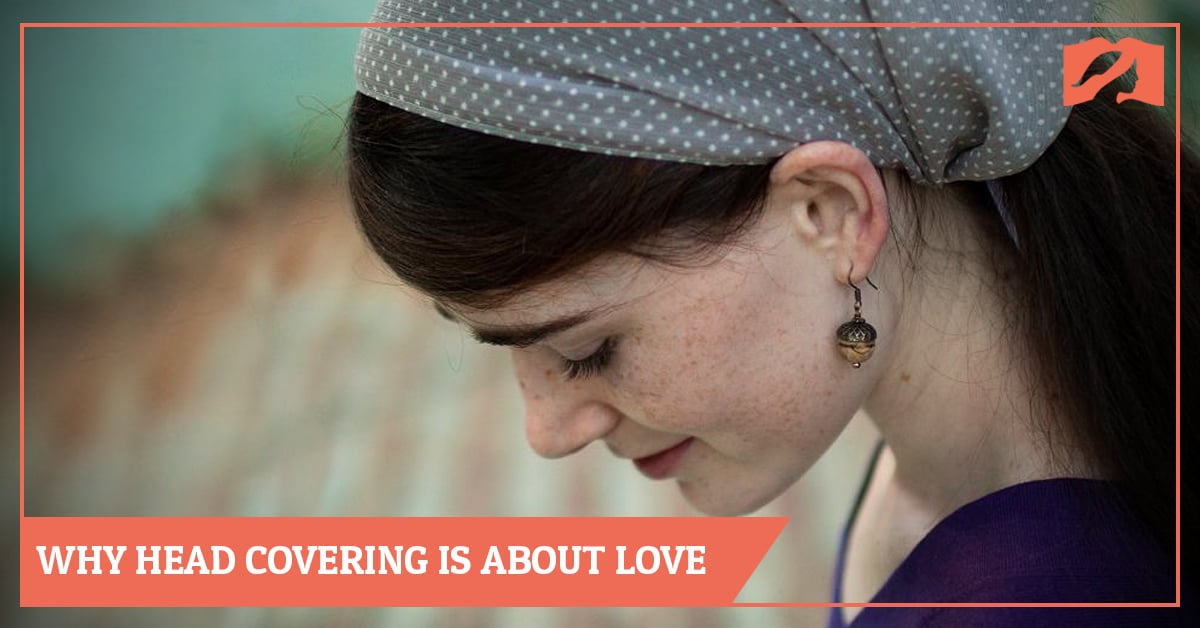
The one thing that has most sustained me through these questions is to rest my eyes on the Savior, and to do it for love of Him.
Many couples are into “love languages.” Even those who aren’t still tend to be familiar with the concept: knowing what speaks love specifically to your spouse. Some people feel most loved through quality time or conversation, others by acts of service, others by thoughtful gifts, others through physical touch, and still others through words of encouragement.
But, have you ever thought about what God’s love language is? God IS love, the Bible tells us. So He is the One Who gets to define it, and He certainly gets to tell us how to love Him.
Scripture actually leaves no question as to what God sees as love toward Himself.
It isn’t passionate words about how much we love Him. It isn’t singing and praising and basking in the emotional glow of worship. It isn’t faithful church attendance and ministry. It isn’t service and sacrifice. It isn’t even reading the Bible, or time spent with Him in prayer.
All of those will be the natural outpouring of a heart that loves Him, and all are necessary — yes!
But one can do all of those things and not love God.
How does God tell us we can show our love for Him?Read more
As the parents of five daughters (from 9 months through 12 years), my husband and I have had to consider whether or not we want them to wear a head covering to church — and if so, at what age they should start. I think this question is very common in families where the mother has started to cover. In this article I’d like to consider this question of age from three angles:
What does the Bible say?
What does this look like practically?
What have we done as a family?
What Does The Bible Say?
When considering any sort of life change, it’s always important to observe what God Himself has said about the subject. So, does the Bible offer any guidance that would help us decide at what age females should start head covering? I believe that it does.
1 Corinthians 11:4-5 says:
“Every man praying or prophesying, having his head covered, dishonoureth his head. But every woman that prayeth or prophesieth with her head uncovered dishonoureth her head: for that is even all one as if she were shaven.”
So, every woman must pray or prophesy with her head covered, or else dishonor her head. But, since the New Testament was originally written in Greek, what does the word woman specifically mean in the original language? Could it mean all females, both children and adults?
An excellent Greek lexicon often utilized in New Testament scholarship is “A Greek-English Lexicon of the New Testament and Other Early Christian Literature”¹ (often referred to as “BDAG”). It notes these three meanings of the word “woman” (or gune in Greek):
an adult female person, woman
a married woman
a newly married woman
So, gune refers to either married or unmarried women, but it apparently does not include female children. In 1 Corinthians 11, this same word is used in verses 3, 5 (quoted above), 6, 7, 8, 9, 10, 11, 12, 13, and 15. In other words, gune is used throughout the whole passage to indicate an adult woman.
According to Bible Study Tools (an online Bible study aid), this same word is used 221 times in the New Testament. In 129 occurrences it refers to “women,” and 92 times it refers to a “wife.” Never is it used in the Bible to describe female children.
Rather than gune, Scripture uses the Greek terms thugatrion (translated as “little daughter”) and korasion (“girl” or “little girl”) when referring to female children. For example, Mark 5:42 uses korasion to describe a 12-year-old girl that Jesus raised from the dead. Along similar lines, Matthew 14:21 lists “women” separately from “children,” indicating that the Greek word for “women” refers to adults.Read more
Preacher: Christian McShaffrey | Sermon Length: 23min | Preached: Aug 14, 2011
Christian McShaffrey is the Pastor of Grace Reformed Church of Reedsburg, WI (a member congregation of the Orthodox Presbyterian Church). He lives in the rolling hills south of town with his wife Kelly and six children. In addition to his domestic and ministerial calling, Mr. McShaffrey serves as the Stated Clerk of his presbytery, advises the board of 89.5 FM-WCNP, and created the website Serious Christianity.
>>> In addition to streaming this sermon above, you can also download it.
[Series introduction:This post is part of a series that will examine what certain leaders in church history believed about head covering. Their arguments, choice of language and conclusions should not be misconstrued as an endorsement from us. The purpose of this series is to faithfully show what they believe about covering rather than only selectively quoting the parts we agree with.]
A.W. Pink (1886–1952), according to his biographer Iain Murray, is “one of the most influential evangelical authors in the second half of the twentieth century.” He pastored churches in the United States and Australia but he is best known for his books such as “The Attributes of God” and “The Sovereignty of God“.
In May 1926, Arthur Pink addressed the congregation of Particular Baptist Church in Sydney, Australia. His topic was “Headship” and the sermon text was 1 Corinthians 11:2-16. Through this sermon we come to understand what Pink believed about the symbol of head covering.
He believed that the symbol should be practiced today and distanced himself from the cultural view. He said that “there are some who claim that much in this first epistle to the Corinthians only had to do with local conditions that then existed and does not apply to the churches of God today. I emphatically deny it.” He also didn’t see this as an insignificant matter. He knew that “there is nothing small or trivial in the things of God” and that “big doors swing on little hinges.” That’s why he exhorted his congregation on this passage. Through his words we see that head covering in Australia was losing popularity even in the 1920’s. He said that wearing one may “cause the world to sneer” and “bring upon you the taunt of ‘old-fashioned'”. He also mentioned that there was “fashion which is increasingly popular among women today” of cutting their hair short, which he was strictly against. This was the era of the first wave of feminism and we see that it was already having a negative impact on biblical gender roles and distinctions. Read more