Marjolein is a Muslim from Holland. She asks us “Why aren’t Christians practicing head covering anymore”. In this video I lay out three general reasons why.
For info on how to submit your own question watch this video:
It’s true. The wife of the Head Covering Movement‘s founder was at a church prayer meeting without her head covered. Let me explain and tell you how I handled it.
Our church recently had a “week of prayer” and on one night they had child care to make it easier for the parents to come out and pray. We took advantage of this and came out as a family. I was in the prayer room a little early while my wife was downstairs getting our children settled away. When she came upstairs to the prayer room, I noticed she didn’t have her covering on. For those who don’t cover all day, it’s an easy mistake to make. So I quietly got up to let her know she had forgotten. She placed a hand on her head to confirm and said “oops”. We’re prepared for situations like this, and store a couple extra coverings in the glove box of our minivan, so she headed out to grab one. A few minutes later she came back to let me know, the back-up coverings were gone. I figured they were as the previous week we had forgotten as well. So on Sunday we used the back-up coverings in the glove box and forgot to replace them. So here we are, at church, about to spend some focused time to prayer and my wife doesn’t have her covering. What should we do? I’ve thought about this situation before, but this is the first time it wasn’t just hypothetical. There are two options 1) My wife sits in the foyer and doesn’t join us for prayer or 2) she comes in and joins us uncovered. Read more
We’re about to start a brand new series where I answer your head covering / 1 Corinthians 11 questions. In this video I explain how you can participate by recording and sending in your video questions.
It’s finally here! Today I’m excited to announce the release of my book Head Covering: A Forgotten Christian Practice For Modern Times. I started writing this book in 2009, so it’s a tremendous blessing to finally be able to release it after seven years of revising and re-vamping, while waiting for the right time to publish. You can get yourself a copy today in paperback or Kindle by clicking the button below.
If you’d like to know more about this book, please visit this page.
4 WAYS YOU CAN HELP
If you consider yourself a part of this movement, here are a few ways you can help me get the word out about this teaching.
Get a copy for you and others in your circle of influence.
Consider giving copies as Christmas gifts to your theologically minded friends and family. Put a copy in your church or local library.
Share the book release.
Can you share the news that the book is now available on your social media accounts and/or your blog? You can direct your followers to christianheadcovering.com. Feel free to use our announcement images which can be found on Twitter/Facebook/Instagram. Use the hashtag #headcoveringbook so we can re-share some of your posts.
Add to Goodreads & leave review.
If you use Goodreads please add the book to your “to read” or “currently reading” lists. Please leave a review there when you’ve finished the book.
Leave an Amazon review.
Amazon reviews are VERY important and they influence people in their purchase decisions. If you could leave a review there when you’ve finished the book that would be a huge blessing.
A sincere thank you to everyone who has helped in promoting this book and teaching.
In 1 Corinthians 11, the Apostle Paul commands the practice of head covering when praying and prophesying. One of the most common objections to this being practiced today is the belief that Paul only commanded it for that specific culture. Whenever someone says this, the first thing I want to ask them is, “which culture?” Corinth was multi-cultural city. So which culture was Paul telling the Corinthian believers to adapt to? In this series of posts we will examine the three different cultures that are relevant, which are Greek, Roman, and Jewish cultures. Today we will answer the question, did Paul command head covering so that believers would not offend Jewish culture?
The Jerusalem Council
Around A.D. 48-49, the apostles and elders met together in Jerusalem to debate what was required of gentile believers who were coming to God. Some of the Pharisees said that Gentiles had to “be circumcised and to keep the Law of Moses” (Acts 15:5). This belief was what led to the council being called. After discussing and debating the issue, they came to a conclusion. They articulated this by letter which was delivered to the churches. Here’s what it said:
For it has seemed good to the Holy Spirit and to us to lay on you [gentiles] no greater burden than these requirements:that you abstain from what has been sacrificed to idols, and from blood, and from what has been strangled, and from sexual immorality. If you keep yourselves from these, you will do well. (Acts 15:28-29 ESV)
The Gentiles were instructed to abstain from four different things so that they would not offend Jewish custom. There was nothing further to be required of them so that there may be “no greater burden”. They didn’t need to be circumcised, they didn’t need to observe feasts and festivals, they didn’t need to do specific washings, and they didn’t need to cover/uncover their heads. No other Jewish practices would be required of Gentile believers. This is significant as the church in Corinth was comprised primarily of gentiles (1 Cor 12:2). So, if Paul were to command the Gentile Corinthians to practice headcovering in order to avoid offending the Jews, that would be contradictory to edict passed down from the Jerusalem council. Read more
[Series introduction:This post is part of a series that will examine what certain leaders in church history believed about head covering. Their arguments, choice of language and conclusions should not be misconstrued as an endorsement from us. The purpose of this series is to faithfully show what they believe about covering rather than only selectively quoting the parts we agree with.]
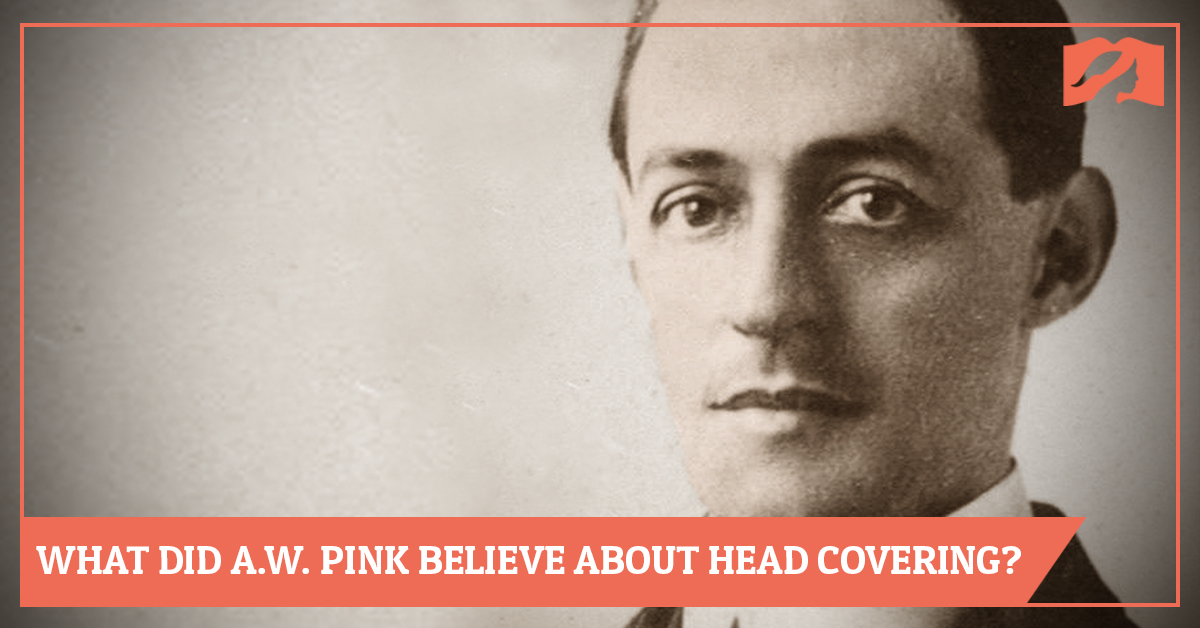
A.W. Pink (1886–1952), according to his biographer Iain Murray, is “one of the most influential evangelical authors in the second half of the twentieth century.” He pastored churches in the United States and Australia but he is best known for his books such as “The Attributes of God” and “The Sovereignty of God“.
In May 1926, Arthur Pink addressed the congregation of Particular Baptist Church in Sydney, Australia. His topic was “Headship” and the sermon text was 1 Corinthians 11:2-16. Through this sermon we come to understand what Pink believed about the symbol of head covering.
He believed that the symbol should be practiced today and distanced himself from the cultural view. He said that “there are some who claim that much in this first epistle to the Corinthians only had to do with local conditions that then existed and does not apply to the churches of God today. I emphatically deny it.” He also didn’t see this as an insignificant matter. He knew that “there is nothing small or trivial in the things of God” and that “big doors swing on little hinges.” That’s why he exhorted his congregation on this passage. Through his words we see that head covering in Australia was losing popularity even in the 1920’s. He said that wearing one may “cause the world to sneer” and “bring upon you the taunt of ‘old-fashioned'”. He also mentioned that there was “fashion which is increasingly popular among women today” of cutting their hair short, which he was strictly against. This was the era of the first wave of feminism and we see that it was already having a negative impact on biblical gender roles and distinctions. Read more
It’s been many months since I updated you on the progress of my forthcoming book on head covering. In this video I let you know how close we are and I unveil (pun intended) the book cover.