So this “head covering movement thing” — what’s it all about? Find out the specifics you’ve been wanting to know in this conversation with HCM Co-Directors David and Jessica. You will also hear about how each of them first came to believe that head covering is for today and became involved with HCM.
>>We now have an official Head Covering Movement Podcast on Spotify!<<
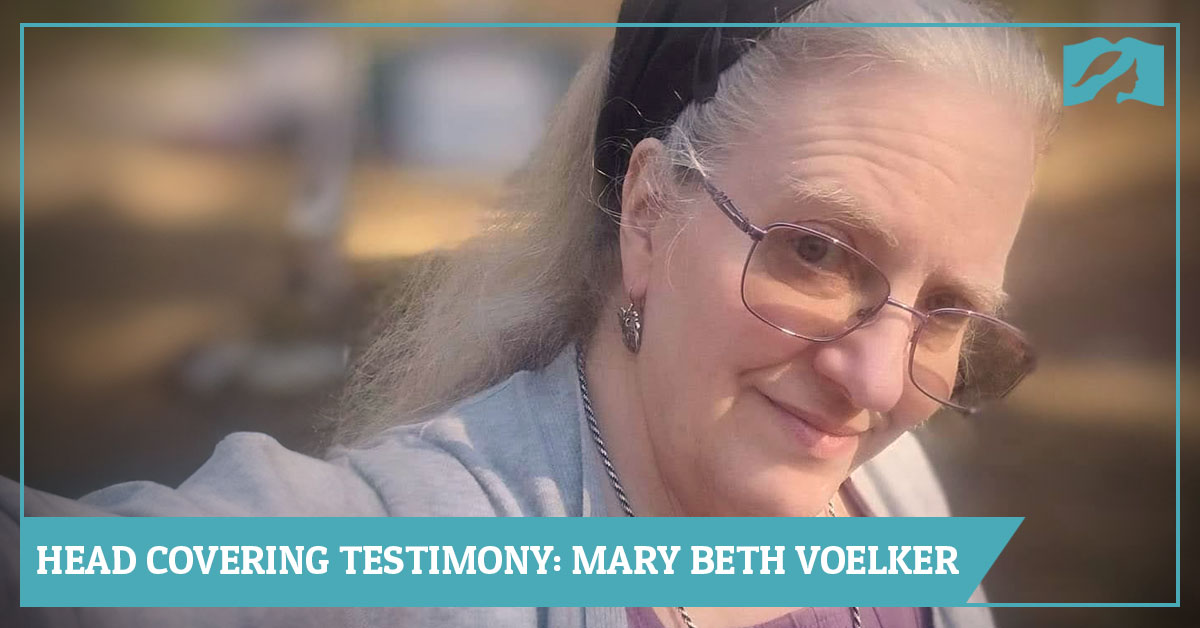
Name: Mary Beth Voelker | Age: 59 | Location: Central North Carolina | Date started covering:Maundy Thursday, 2023
1) Please introduce yourself to our readers.
I’m a writer, stained glass artist, and deli clerk. I’ve been married for 35 years and have 4 children and 2 grandchildren. Over many years of doing many different things, I’ve been granted the understanding that God put me on earth to make stuff and feed people. I’ve lost count of the number of hobbies and crafts I’ve tried, but stained glass is the first one that shows a real prospect of turning into a profitable business.
2) Where do you attend church? Tell us a little bit about it. Do others practice head covering there?
I attend Grace Church, a large non-denominational, evangelical, contemporary church in central North Carolina. My husband and middle son are employed as tech staff, primarily serving at one of the multi-sites where our youngest son also volunteers as tech crew and I serve on the hospitality team. My job is feeding the volunteers. It makes for a long day, especially for the tech-and-worship workers, as they don’t rotate out between services (unlike the greeters, ushers, and the children’s team).
We’re a Gospel-focused church with the formal mission to “Fill the city with Jesus.” We’re very conservative in many ways, such as only ordaining male ministers. But in a racially and ethnically diverse area where we focus on reaching those who don’t know Jesus at all, we’re very casual and low-key about dress code expectations and other trappings that would be familiar to people who grew up in mainline churches.
I may or may not be the only person covering among 200-300 people attending either the multi-site where I serve or the Thursday night service I sometimes attend. I don’t know about the 800-1000 or so people on Sunday morning at the main campus since I haven’t been there in a number of years, though I do remember one particular lady in the children’s ministry who always wore cute hats. I don’t know if she was covering religiously or just liked cute hats.
Head covering is not a topic that has ever been addressed from the pulpit. I hate to say it, but getting the young guys out of their ball caps might be more of a priority if the topic were to ever come up.Read more
I began covering in the Fall of 2012, and the journey has been amazing. Where I’m standing now isn’t the same place I started, as I can see when looking back on the past nine years. Head covering has taught me some important life lessons.
And right now, I bet I already know what you’re thinking: I’m about to say that head covering helped me learn to be a more submissive wife. Though that is certainly true (and I will be coming back to that in a moment), there are actually some other ways head covering changed me that aren’t as obvious.
The Less Obvious
To start with, I used to be a little afraid to be different. I didn’t want people to think ill of me. On the contrary, I wanted to impress them with how smart and how pretty I thought I was! I can see now that I was insecure and guided by vanity. Head covering changed all that.
As a result of head covering, I’ve given up on those things. I haven’t given up on trying to look pretty or be smart, but I’ve given up on caring about people thinking that I look pretty or that I’m smart.
I suspect they think I’m a little different, maybe even ignorant and unbalanced, and I’ve arrived at the point where I’m okay with that. I don’t need their approval and I don’t care what they think of me (okay, I actually do still care — just not as much as before). What freedom to let go of the need to live up to other people’s expectations, and to not worry about their opinion of me!Read more