I am a complementarian. This means I believe that while men and women are both created in the image of God and are equals in value and worth; they each serve a different function. In the home, the husband has been given the authority (headship) to lead his wife whereas the wife was created to help her husband and follow his leadership (submission). I believe the authority and submission in the home, pictures the relationship between Christ and His church. I also believe this was God’s original design; a pre-fall masterpiece, not a post-fall disaster.
I am encouraged by the large resurgence of complementarians and the numerous biblical scholars who defend this truth. They uphold male authority and female submission in the home and believe the office of elder (pastor) is for men only.
Within complementarianism, I hold to what is now a minority position. I believe that the functional difference between men and women should be symbolized to both men and angels when the church gathers together for worship. Yes, I believe that head covering (as taught in 1 Corinthians 11) is a timeless, transcultural symbol for Christians under the new covenant. Read more
Philip Gardiner has been the minister of Carrickfergus Free Presbyterian Church in Northern Ireland since January 2007. He was trained at the Whitefield College of the Bible (Northern Ireland). He is currently awaiting confirmation of a visa to go to Australia to be the minister in Perth Free Presbyterian Church. He is married to Cherith and they have two young daughters.
This sermon was preached on Nov 18, 2012 at a youth meeting in Mount Merrion FPC in Belfast. Though it was delivered to youth, it is a sermon that transcends age. In only 38 minutes Philip Gardiner makes a positive case for head covering, speaks about the various objections and explains the principle of headship which the symbol points to. In such a short time he covers an astonishing amount of ground, thoroughly. One thing that stands out in this sermon is Philip’s heart and concern for the things that are greater than the symbol of covering. He asks of the Lord in prayer, “that our lives might be brought into conformity to the Word of God, not merely in the outward practice, but also in the heart“. He shows concern that some objections (particularly, seeing Paul as a Chauvinist–bringing his own cultural views of men/women into the Scripture) undermine the inspiration of Scripture. Also at the end he makes an appeal for everyone to be under the more important covering, the “covering that there is in the precious blood…that covers your sin”. We commend this sermon to you as a short, but jam-packed introduction to head covering.
>>> In addition to streaming this sermon above, you can also download it.
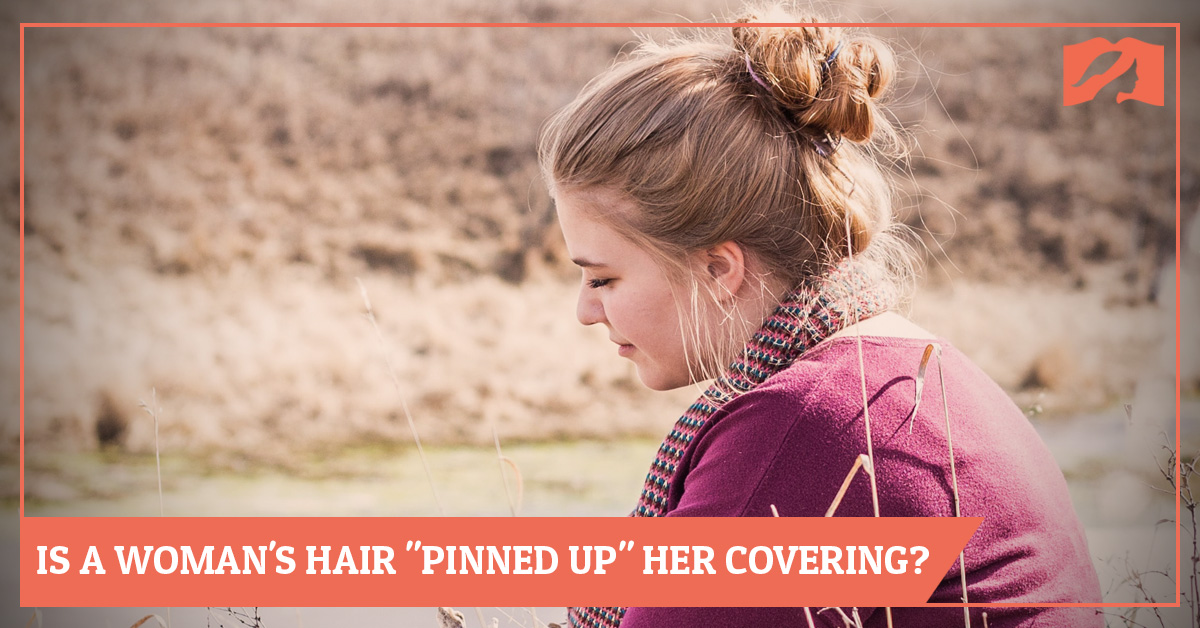
The Objection: The Greek word “Akatakalyptos” is incorrectly translated as “uncovered” or “unveiled” in English translations of the Bible. A more accurate rendering would be “unloosed”. Paul is not commanding women to wear a head covering, but is telling them to pin/bundle their hair up instead of letting it hang down their backs.
This view was articulated by James B. Hurley (Professor of Marriage and Family Therapy, RTS Jackson) who said:
…the custom in view was not the wearing of the shawl but rather the wearing of that hair style which marked a woman in proper relation to her husband or father. It was the custom of women to wear their hair pinned up in a “bun” rather than hanging loose. 1) Did Paul Require Veils or the Silence of Women? A Consideration of 1 Cor 11:2-16 and 1 Cor 14:33b-36 (Volume: WTJ 35:2 – Winter 1973)
How is this view supported? Dr. Hurley says the most “fruitful text” to study is how the Septuagint translates Leviticus 13:45. The Septuagint (also known by the abbreviation, LXX) is a Koine Greek 2) The language the New Testament was written in.
translation of the Old Testament. It was the Bible used by Greek speakers in the time of Jesus and the Apostles. So let’s first take a look at this passage Dr. Hurley mentioned with a special focus on the Hebrew 3) The language the Old Testament was written in.
word behind hair “hanging loose”. Read more
References
1.
↑ Did Paul Require Veils or the Silence of Women? A Consideration of 1 Cor 11:2-16 and 1 Cor 14:33b-36 (Volume: WTJ 35:2 – Winter 1973)
“…the thing that is most astonishing here is that he appeals to creation, not to Corinth. If anything transcends local custom it is those things that are rooted and ordered in creation. That’s why I’m very frightened to be loose with this passage.” – R.C. Sproul 1) Quoted from R.C. Sproul’s sermon ‘To Cover or Not To Cover’ available at www.ligonier.org/learn/series/hard_sayings_of_the_apostles/to-cover-or-not-to-cover/
There are four reasons for head coverings that the Apostle Paul gives in 1 Corinthians 11. The very first of these is the foundation; the deeper reality that head coverings point to. When a new believer is baptized they’re symbolizing their death to their old life & new life in Christ (Rom 6:4). When a woman prays with her head covered and a man prays with his head uncovered they too are symbolizing something greater. Let’s take a look at this foundation. Read more
Head coverings are not a popular doctrine. In fact, that’s quite the understatement. So why would I start a movement based upon it? Do I enjoy controversy? Absolutely not. Looking to be divisive? The opposite. Then what would possess me to do such a thing? The short answer is, because it’s in the Bible. See, if “all Scripture is inspired by God and profitable for teaching, for reproof, for correction, for training in righteousness” (2 Tim 3:16) then all Scripture deserves fair treatment. On top of that, this particular topic is not just mentioned in the Bible, but it’s defended. It’s not just one or two obscure verses but it occupies 15 consecutive verses. We can debate what Paul meant and we can debate how it applies in the 21st century, but the one thing we can’t do is ignore this topic. Read more