Frequently Asked Questions
Find clear, thoughtful answers to the questions Christians most often ask about head covering.
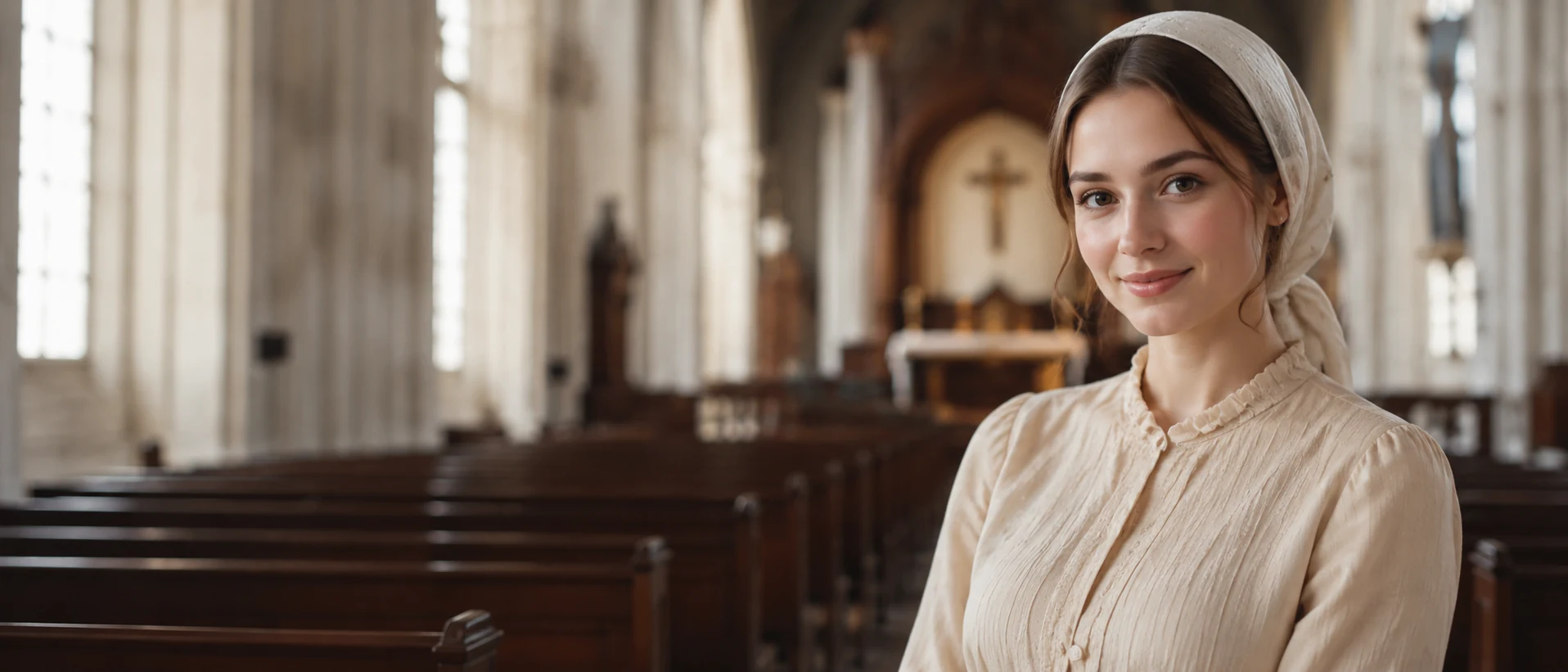
1 Cor. 11:2–16 and the practice of head covering are being rediscovered by many Christians today. Since recent generations often lack familiarity with the practice, those who begin exploring the topic naturally have questions. Some may also begin with confusion, discomfort, or misunderstandings.
We have heard head-covering-related questions and objections from thousands of people through the website, email, and social media. This page answers ten of the most common questions. We hope these answers provide biblical clarity and peace about this beautiful but often-forgotten Christian practice.
The New Testament teaches that men should worship with their heads uncovered and women should worship with their heads covered. This instruction is found in 1 Cor. 11:2–16, where Paul speaks specifically about men and women praying and prophesying.
We believe that when men worship with a bare head and women with a covered head, they display how God created men and women differently (Gen. 2:18–24; 1 Cor. 11:7–9). The covering is a visible symbol of God’s order and design. It does not make a woman more spiritual, nor does it make her right with God. It is an act of obedience that points beyond itself to important truths about headship, submission, glory, and worship.
There are five main reasons Paul gives for this practice:
- Apostolic tradition: Paul commends the Corinthians for holding firmly to head covering as an authoritative apostolic tradition that he had delivered to the churches.
- Creation order: Paul grounds the symbol in God’s order of headship and in the distinct glories of man and woman established at creation, before the fall.
- Angels: Paul says women should cover “because of the angels,” reminding us that the gathered church worships before heavenly witnesses who observe God’s order on display.
- Nature: Paul points to the natural distinction between male and female hair as support for the corresponding distinction of men worshipping uncovered and women covered.
- Church practice: Paul appeals to the shared practice of the churches of God, showing that head covering was neither optional nor confined to Corinth.
No. Although every biblical command was originally given within a particular culture, Paul does not base head covering on a local Corinthian custom. He grounds it in truths that reach far beyond first-century Corinth.
Paul appeals to the order of creation, the angels, nature, and the practice of the churches (1 Cor. 11:7–16). None of these reasons is limited to a particular city or century. He also instructs men to worship uncovered (1 Cor. 11:4), showing that this is not simply a women’s issue. Cultural explanations generally focus on women alone, whether by claiming that an uncovered woman would be mistaken for a Corinthian prostitute or that a covering identified her as a faithful married woman.
The surviving evidence does not support the idea that respectable women in Corinth were expected to keep their heads covered in public. Public marble portraits from Roman Corinth most often show women bare-headed, which indicates that this was socially acceptable. Religious customs also varied. Greek men and women generally worshipped uncovered, Roman men and women covered their heads during public religious acts, and first-century Jewish practice did not require men to uncover. None of these customs matches Paul’s instruction that men pray and prophesy uncovered while women do so covered.
Paul was not repeating a familiar Corinthian, Greek, Roman, or Jewish custom. He was teaching a distinctly Christian symbol, practiced by the churches and grounded in the theological reasons he gives in the passage.
Paul speaks of two coverings in 1 Cor. 11. A woman’s long hair is her natural covering. It is permanent and is a glory to her (verses 14–15). The second covering is removable, worn while praying or prophesying (verses 4–5), and serves as a symbol that she is under authority (verse 10). One is her glory; the other covers her glory.
Verses 5–6 require this distinction. Paul says that if a woman refuses to cover her head, she should also cut off her hair. If being uncovered meant having short hair, his instruction would amount to saying, “If she has short hair, let her cut her hair short.” Paul instead appeals to a woman’s long hair to show that nature itself gives her a covering and thereby teaches that being covered is fitting for her in a way it is not for a man. The Christian practice, in which women worship covered and men worship uncovered, therefore accords with the distinction nature displays through their hair.
The long-hair-only interpretation is also historically recent. Our research traces it to the German liberal theologian Karl Holsten in the late nineteenth century. It did not gain wider acceptance until the twentieth century, when Abel Isaakson published an extended scholarly defense in 1965.
Paul specifically connects head covering with “praying or prophesying” in 1 Cor. 11:4–5. We believe the primary setting he has in view is gathered Christian worship, where the distinction between male and female is displayed before the church and the angels (1 Cor. 11:10; Eph. 3:10).
The clearest application is therefore that women should cover their heads during the church’s worship, while men should keep their heads uncovered. Christians who affirm head covering sometimes differ over how broadly to apply this principle. Some women cover only during the Sunday worship service. Others also cover for family worship, Bible studies, or private prayer. Still others, based on Paul’s command to “pray without ceasing” (1 Thess. 5:17), believe they should cover full-time.
We believe there is room for thoughtful disagreement over some of these applications. However, the uncertainty surrounding the outer limits of the practice should not keep us from obeying it in its clearest setting: the gathered worship of the church.
We believe Paul’s instruction applies to women generally, not only to wives. The Greek word he uses can mean either “woman” or “wife,” so the context must determine which meaning is intended.
Paul’s argument concerns the created order of men and women as a whole. Every man has Christ as his head, not only husbands (1 Cor. 11:3), and Paul says that woman came from man, not that wives came from their husbands (verses 8–9). He also appeals to the natural distinction between male and female hair, a distinction that applies regardless of marital status (verses 14–15). When he says that “every woman” who prays or prophesies uncovered dishonours her head (verse 5), there is no reason to exclude single women.
A single woman who covers is acknowledging God’s order for men and women and showing respect for the principle of male headship even if she never marries. Depending on her circumstances, she lives out this principle by obeying her father while she remains under his authority (Eph. 6:1) and by submitting to the church leaders who watch over her soul (Heb. 13:17).
Paul’s word refers to adult women rather than young girls, so the passage does not directly command children to cover. Parents may still introduce the practice earlier as a way of teaching and preparing their daughters, but that decision belongs to each family.
No. The instruction in 1 Cor. 11:2–16 is a New Covenant practice delivered by an apostle to Christian churches. Scripture assigns some symbolic practices to particular covenants: circumcision belonged to the old covenant administration (Gen. 17:9–14), while baptism and the Lord’s Supper belong to the New Covenant church (Matt. 28:19; 1 Cor. 11:23–26). In the same way, head covering was not commanded to women under the Old Covenant. Paul presents the covering of women and uncovering of men during prayer and prophecy as a distinctively Christian symbol.
Old Testament passages do describe women wearing veils. Rebekah, for example, covered herself when she learned that the man approaching was Isaac (Gen. 24:64–65). But Gen. 24 narrates what she did; it does not command other women to imitate her. A descriptive passage tells us what happened, while a prescriptive passage tells God’s people what they must do. Because the Old Testament contains no general command requiring women to veil, Rebekah’s action reflects the culture of her setting rather than an Old Covenant ordinance.
By contrast, 1 Cor. 11 directly instructs Christian men and women to cover or uncover their heads while praying and prophesying (verses 4–5). It is prescriptive teaching for the New Covenant church, not an Old Testament command being carried forward.
No. We are saved by grace through faith in Jesus Christ, apart from works (Rom. 3:28; Eph. 2:8–9). Wearing a head covering cannot earn salvation, keep someone saved, or make a person right with God.
Legalism occurs when people trust in their obedience for acceptance with God or create human laws and bind the consciences of others where Scripture has left them free (Mark 7:7–8; Rom. 14:1–4). Simply believing that Christians should obey a biblical command is not legalism. Otherwise, teaching any Christian duty could be dismissed in the same way.
Head covering should be practiced in faith, out of love for Christ, and with a desire to honour God’s Word. It should never become a source of pride or a reason to treat uncovered women as spiritually inferior. At the same time, the fact that a command does not save us does not make it unimportant. Christians obey because they have been saved, not in order to be saved (Eph. 2:10; John 14:15).
In 1 Cor. 11:2–16, Paul uses a verb that commands a woman to cover her head. He does not use a noun that names a particular garment. The command is therefore to perform an action, not to wear one prescribed style such as a veil. A woman may use a veil, scarf, kerchief, hat, headwrap, or another recognizable covering suitable for Christian worship.
The covering should be substantial enough to function as a genuine head covering rather than merely a decorative hair accessory. At the same time, we should be careful not to turn our personal preferences into rules that Scripture does not give. The goal is to honour the biblical symbol, not to insist that every woman look the same.
Women should consider the customs of their church, their own practical needs, and whether the covering clearly communicates what it is intended to represent. A simple and modest covering is often the easiest place to begin. Over time, many women find a style that feels natural and appropriate for them.
If your husband objects to head covering, begin by taking his concerns and his God-given authority seriously (Eph. 5:22–33; 1 Pet. 3:1–6). A covering is meant to symbolize that a woman is under authority (1 Cor. 11:3, 10), so wearing it with a defiant spirit would contradict the truth it represents. Pray for unity, listen for the concerns beneath his objection, and ask whether he would be willing to study the passage with you. Explain your conviction gently rather than nagging or treating him as an obstacle to overcome.
If he still disagrees, ask whether he can still grant you permission to cover. He may be comfortable with the practice if certain modifications are made, such as choosing a style he likes or one that draws less attention. A wife should be very slow to disregard her husband over a symbol of submission. If he will not grant permission, she should remain uncovered while continuing to pray, trusting that God sees her willingness to obey and will hold her husband accountable for how he leads (1 Pet. 3:7).
In a church that does not practice head covering, follow your conviction with humility, discretion, and a desire to preserve peace. Choose a simple, unobtrusive style that does not draw unnecessary attention, and do not pressure other women or repeatedly debate the church’s position. If your pastor raises concerns, ask privately for permission to follow your conviction about this biblical and ancient Christian practice. Reassure him that you are not trusting in the covering for salvation, judging uncovered women, or seeking to create division.
A solid church should not be rejected merely because it does not teach head covering. Faithful preaching, sound doctrine, godly leadership, and a healthy church body carry more weight. If the church allows you to practice quietly, join it to grow and serve, not to change it, and be known for encouraging its leaders more than debating them.
Paul does not explain the phrase in 1 Cor. 11:10, so we should not claim more certainty than Scripture gives. The most likely meaning is that angels are present as witnesses when Christians worship. Scripture depicts angels observing what God is doing through the church (Eph. 3:10; 1 Pet. 1:12). Their presence reminds believers that worship takes place before both a visible and an invisible audience.
In that setting, the covered heads of women and uncovered heads of men visibly honor the order Paul has just described. The angels would see in the gathered church a faithful picture of God’s order, while believers are reminded to worship obediently and reverently in the presence of these heavenly witnesses.
Paul is not warning that an uncovered woman might attract fallen angels or the “sons of God” from Gen. 6. That explanation does not account for Paul’s instruction that men worship uncovered, nor does it fit the passage’s gathered-worship setting. If a covering were intended to preserve a woman’s modesty from fallen angels, it would need to be worn at all times, not only when the church gathers.
No matter the meaning Paul intended, what we do know is that angels are not bound to any particular time or culture. Paul’s appeal to them therefore shows that his instruction was not limited to first-century Corinth.
Still Have Questions?
Explore our guided study of 1 Cor. 11, browse additional articles, or connect with other Christians who are studying and practicing head covering.