In this article, David Phillips presents a different perspective on the location of head covering than is held by HCM founder Jeremy. You can read Jeremy’s view here.
HUMAN QUESTIONS & BIBLICAL ANSWERS1)
Both the Apostle Paul and the First Century churches promoted the standard use of head coverings by Christian women (1 Corinthians 11:16). However, in our modern era, a follow-up set of practical questions is often asked: “During what times and in what situations does God intend for a head covering to be worn?”2)
I believe that there are two primary reasons why these questions often prompt curiosity and confusion.
First, not knowing the “when and where” for the use of a covering is simply a natural consequence of losing the original practice of head covering within modern mainstream Christianity. In other words, many believers don’t have the opportunity to observe (and follow the example of) other Christian women modeling the biblical practice of head covering. Second, believers tend to lean on their own personal convictions in answering the “when and where” questions. And Christians have a wide variety of those convictions!
Fortunately, the Bible readily (and repeatedly) gives us the context for the practice of head covering. Under the inspiration of the Holy Spirit (2 Peter 1:21), Paul wrote that a covering is to be used during a believer’s active communication to and from God – that is, during prayer and prophecy.3)
SCRIPTURAL BOUNDARIES?
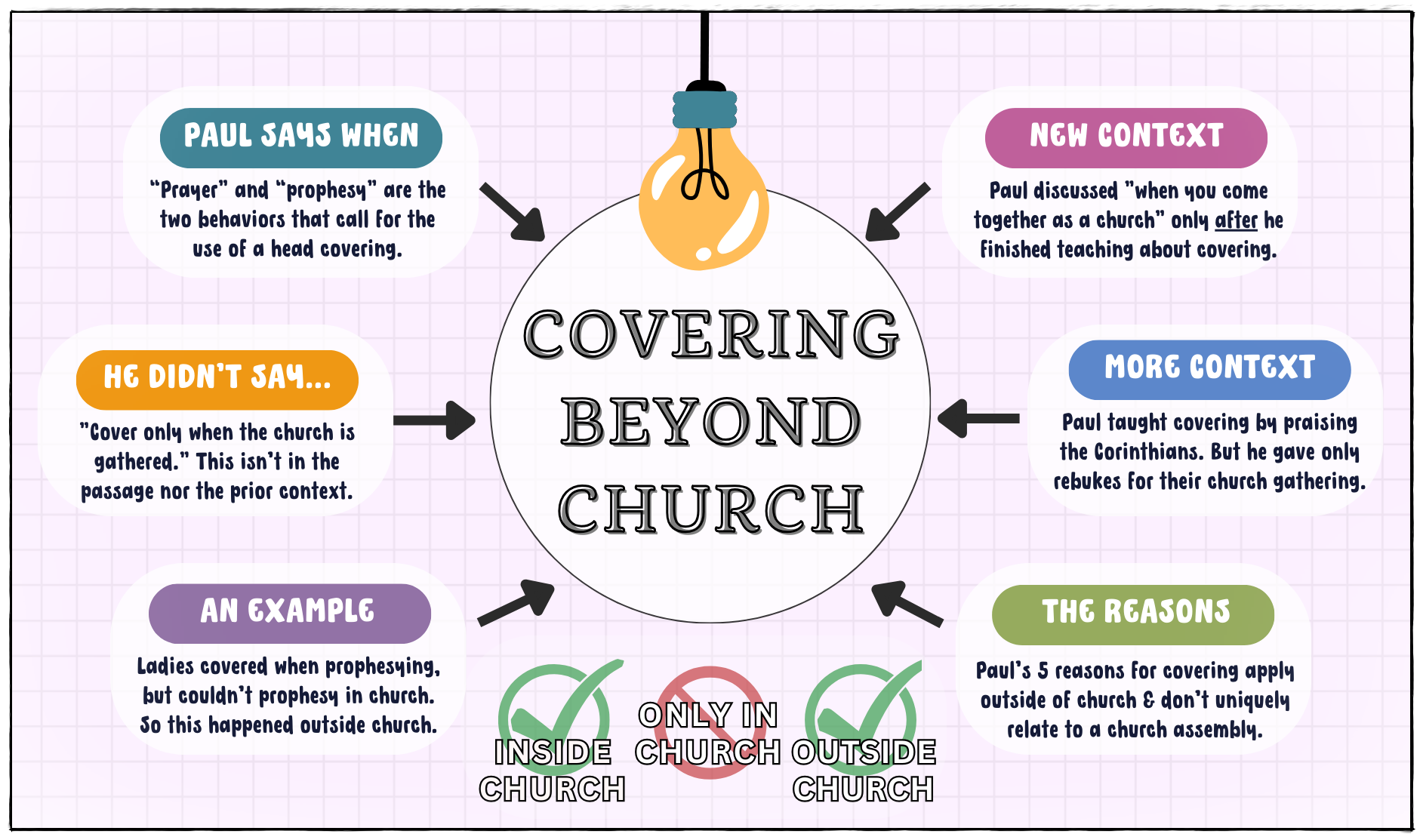
Prayer and prophecy can obviously happen at a variety of times and in a variety of locations. It is noteworthy, therefore, that Paul does not provide any location-based constraints for the use of a head covering while praying or prophesying.
More specifically, a restriction such as “cover your head only when the local church is assembled” is simply not provided in the immediate passage nor the preceding context. Therefore, we should be careful not to accidentally add this man-made limitation to Paul’s inspired words.4)
Instead, we should observe what Paul did write. After stating that prophecy is one of the two behaviors that call for a head covering, he then soon explains that ladies aren’t permitted to prophesy during the local church assembly (1 Corinthians 14:33-35). This indicates that the (covered) ladies were prophesying in a non-assembly context, and thus the covering was not intended to be limited to the formal gathering of the church.
The original New Testament churches often met in homes instead of “church buildings.” However, we do not see Paul teaching that coverings should be worn upon entering a church building (or when entering a home during the time that it is used as a church building). He also did not say that the covering is for use only in a church building. Again, these kinds of parameters would be “creative” additions not found in the passage. Instead of specifying that the cover is for use when entering certain holy buildings, Paul instructs that the cover is for use when engaging in certain holy behaviors.5)
A KEY TRANSITION
Paul provided us with instructions about the practice of head covering in the first 16 verses of 1 Corinthians 11. But in the very next verse (v. 17), we find one of the strongest indications that his directions about covering were not given in the context of the local assembly. Immediately after Paul ends his discussion of head covering, he transitions to a different topic and context using the phrase, “when you come together as a church” (verses 17-18).
Paul has now mentioned the church “coming together” for the very first time in this chapter, and he then begins to speak of it somewhat frequently.6) This all happens only after he has finished discussing the practice of head covering.
Also, notice how Paul introduces7) this topic of the Corinthians “coming together.” He begins by declaring that “I do not commend you.” This is because their church gathering routinely turned out “not for the better, but for the worse” (verse 17). Unfortunately, each time he speaks in this chapter about the Corinthians’ gathering, he is correcting their wayward behavior.
Paul’s heavy criticism regarding the church’s act of “coming together” stands in stark contrast to the praise he gave them when beginning his discussion about head covering (verse 2). If the Corinthians’ local gathering was so grievous that it risked the Lord’s discipline and judgment,8) then Paul’s earlier multifaceted praise could not be in the context of their assembly.
This distinction between Paul’s praise (first half of the chapter) and his rebuke (second half of the chapter) matches with the clear change of context expressed during the transition (verse 17) between the two halves.
SCRIPTURE ALONE
Finally, consider the five reasons that Paul gave to support the practice of head covering. Throughout the first 16 verses in 1 Corinthians 11, Paul explained that the practice of head covering is based on headship, glory, the angels, the gender-based differences in natural hair lengths, and the standard practice of the churches. Not only are all his reasons valid and applicable regardless of where prayer and prophecy occur, but these reasons for covering do not exclusively relate to Sunday morning services.
Throughout the passage, we’ve seen that Paul provided multiple indications that the practice of head covering was not limited to the corporate gathering of the local church. Instead, Paul took the time to specify exactly which behaviors (prayer and prophecy) call for the use of head coverings. Likewise, Christian men even nowadays will often remove their hats during times of prayer, including prayer outside of church gatherings.9)
When we accept the plain reading of Scripture as sufficient, one positive side-effect is that we avoid creating extra-biblical requirements for Christian behavior.10) Unfortunately, a variety of denominational traditions have created additional criteria for the practice of head covering, which can often lead to a variety of unnecessary and awkward rules.11)
• Deciding whether a 15-minute “fellowship break” counts as “corporate worship” and therefore requires the use of a head covering (even if no prayer or prophecy happens during that time).
• Evaluating which Christian activities are done under the authority of the church elders (as distinct from activities done under the approval of the church elders), and then basing your use of a head covering on that evaluation.
• Deciding when the elders’ involvement doesn’t matter anyway, because you can instead just evaluate whether a Christian event is patterned close enough to a traditional church service, and then decide whether to use a head covering.
• Deciding whether God requires a head covering for other events based only on your conscience telling you that He does or doesn’t require it.
• Deciding that you might be able to skip a head covering altogether during female-only worship, if there are absolutely no men in the immediate area. Instead, may believers today receive clarity and confidence by considering afresh the question of “when and where” using a sola scriptura approach. Paul’s simple and direct guidance for the use of coverings is “when praying or prophesying.”
References
• Deciding whether a 15-minute “fellowship break” counts as “corporate worship” and therefore requires the use of a head covering (even if no prayer or prophecy happens during that time).
• Evaluating which Christian activities are done under the authority of the church elders (as distinct from activities done under the approval of the church elders), and then basing your use of a head covering on that evaluation.
• Deciding when the elders’ involvement doesn’t matter anyway, because you can instead just evaluate whether a Christian event is patterned close enough to a traditional church service, and then decide whether to use a head covering.
• Deciding whether God requires a head covering for other events based only on your conscience telling you that He does or doesn’t require it.
• Deciding that you might be able to skip a head covering altogether during female-only worship, if there are absolutely no men in the immediate area.